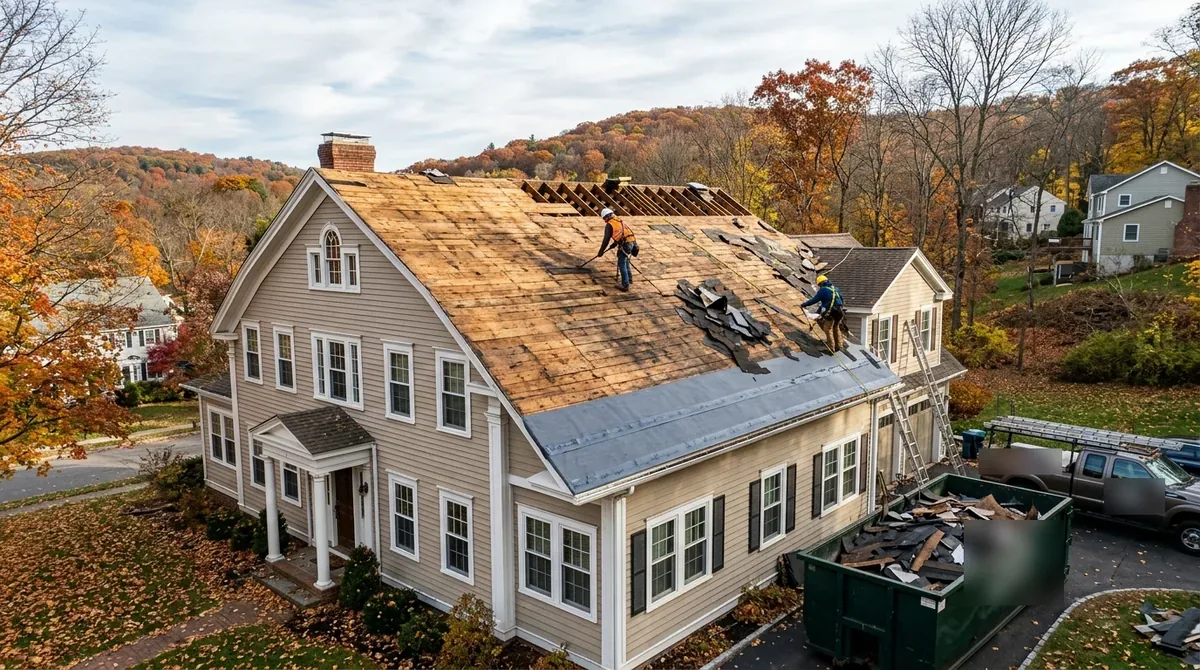
Roofing in Waterbury, CT, measured against Connecticut's own 25 percent line: what counts as a repair, what needs a permit, and what the code then asks of the roof.
In Waterbury every full re-roof is a permitted job, because Connecticut's code excuses only repairs under a quarter of the roof. That is not red tape: the permit is what makes the ice barrier, the deck-joint strip and a city inspection part of the roof you are paying for.
A typical asphalt roof replacement in Connecticut is estimated at $10,000 to $18,000, with architectural shingle running about $4.50 to $8.00 per square foot installed. Where a house lands in that range depends on the roof area, the pitch, how many layers come off, and how much of the deck turns out soft once they do.


Estimated Connecticut ranges for the work this site covers, before anyone has seen your roof. Each service page breaks its own figure down; this is the overview. A full replacement also carries Waterbury's permit fee, about $380 on a $14,000 job.
Price follows roof area, pitch and valleys, not floor area: a two-story house has a smaller roof than a ranch of the same size.
Three stories, a steep or rocky lot, or a crowded street add staging and time, and on many Waterbury streets that is as much of the price as the shingles.
Layer count and deck condition are only certain once the attic has been seen, which is why decking is quoted as a rate per sheet.
What this often turns out to be instead, and the cost of each.
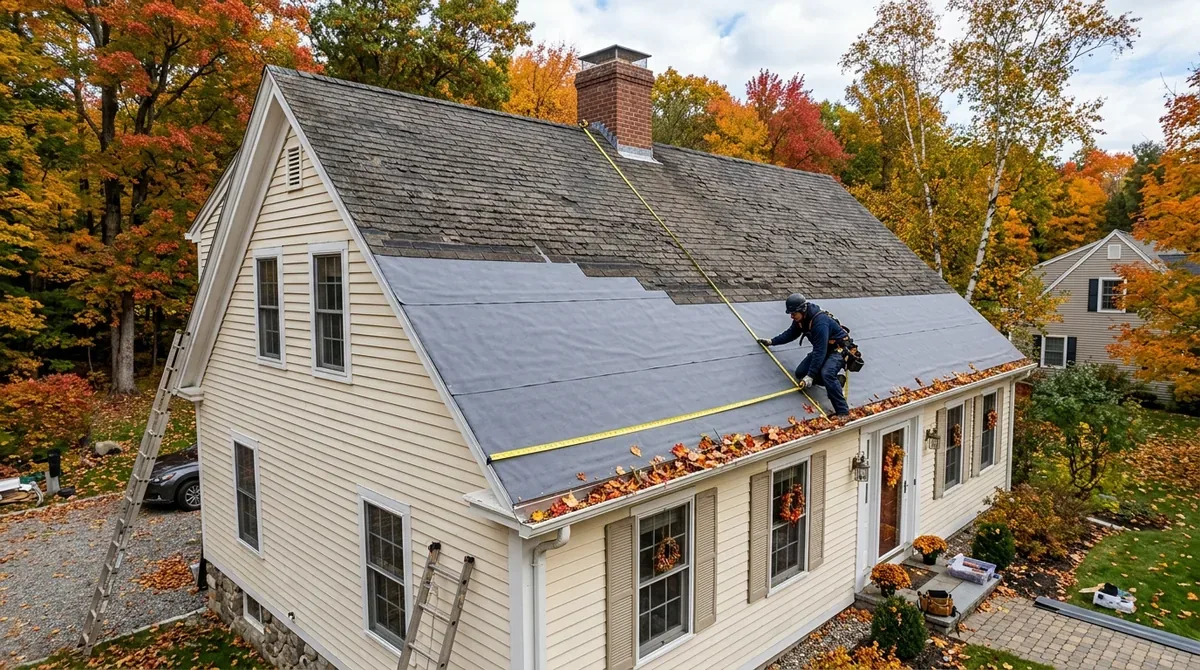
Leaks traced from the attic, fixed with laps and new metal, and kept under the 25 percent line wherever the roof allows.
Water coming in tonight: covered first, photographed, and quoted properly in daylight.
Porch roofs, rear additions and multi-family blocks, detailed at the walls where low slopes actually fail.
Slipped and broken slates replaced on hooks or copper nails, for the houses that still carry their stone.
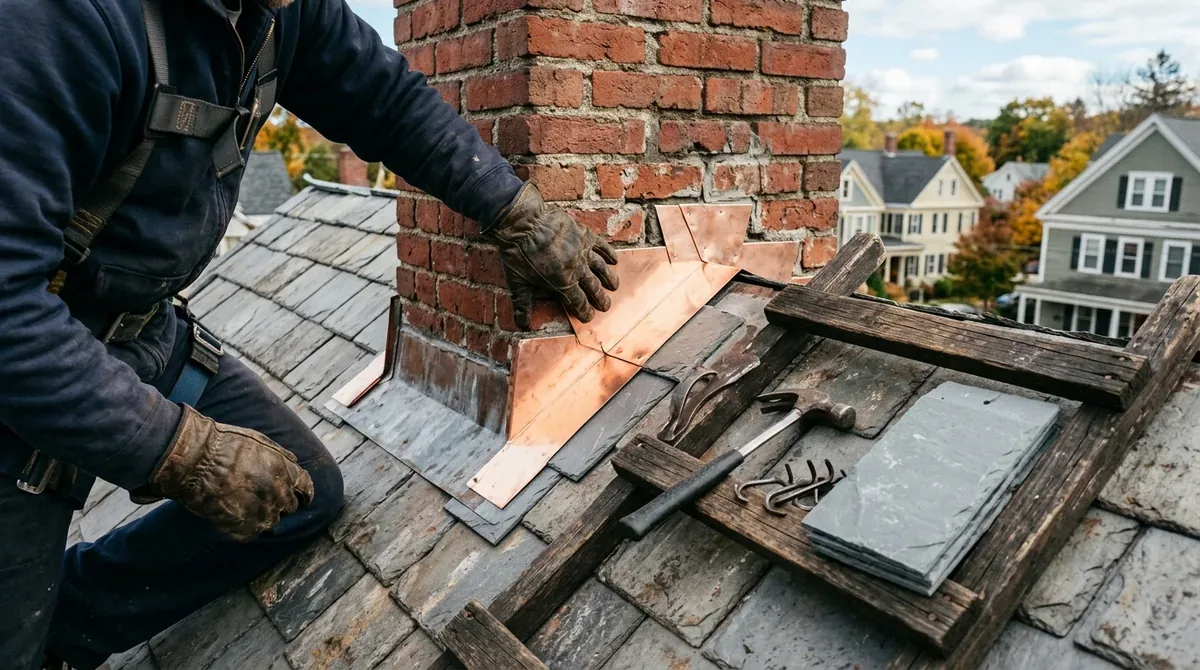
Step, apron, cricket and counter-flashing renewed, with the mortar behind them made sound first.
A written, photographed answer on how long the roof has left, and which side of the line the work falls.
Four checks that decide it, in the order they should be made.
Connecticut's code excuses from a permit only repairs limited to 25 percent of the roof covering in one calendar year. Work under that line on a one- or two-family house is a repair. Work over it is a replacement, and it is permitted and inspected as one.
The code allows no new covering over two existing layers, over slate or tile, or over a covering that is soaked or deteriorated. If the attic shows two layers already, the decision has been made for you.
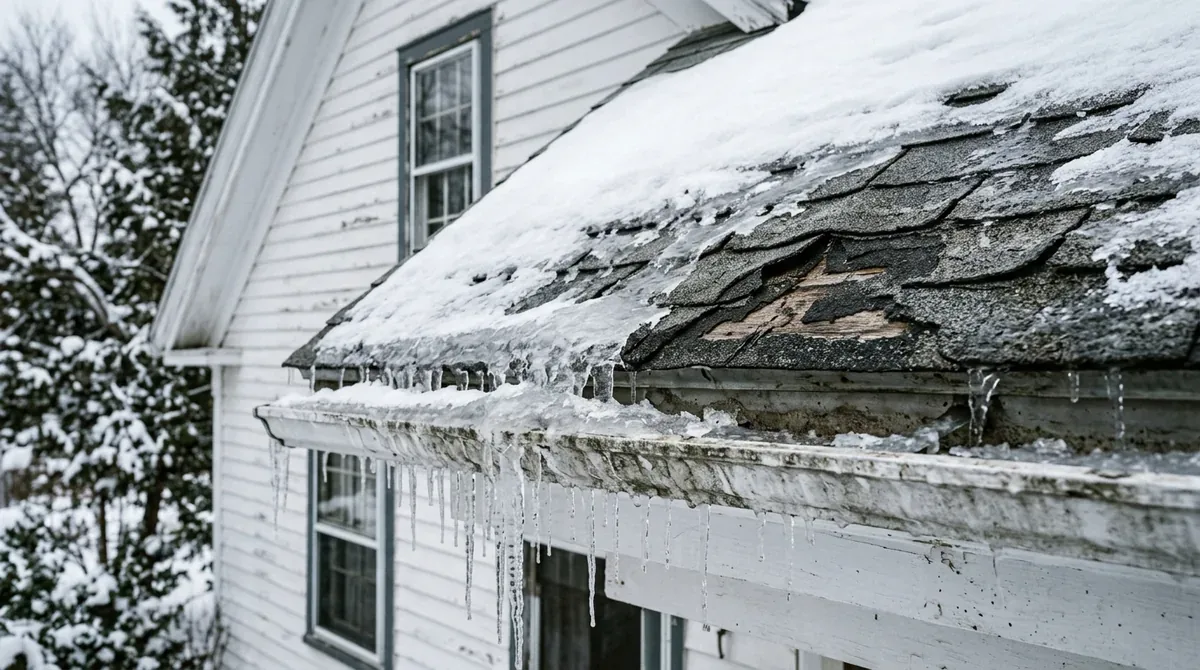
A roof that leaks at the eaves every thaw is usually missing ice barrier. A patch cannot add it. A permitted replacement must, from the eaves to at least 24 inches inside the wall line.
A $1,500 repair on a roof with ten good winters is money well spent. The same repair on a roof with two is a down payment on a replacement, and it is worth hearing that before you pay it.
Free inspection, a written quote, and a plain answer on the 25% permit line.
Tell us the address, what prompted the call, and whether the house is one, two or three family. On a rented floor, say so: getting to the top-floor ceilings and the porches is usually part of the visit.
The slope and the details that fail, then the attic: layer count, deck type and old water tracks. On pre-war stock the attic usually settles whether the deck is boards or plywood, which changes what Connecticut's code asks for at the deck joints.
The work in plain language, decking as a rate per sheet, and a plain statement of whether the job is a repair under the 25 percent line or a permitted replacement. Our registration number and the start and completion dates go on the contract, as the Home Improvement Act requires.
A permitted job gets the city's inspection, the one independent look the roof will ever have. We go round it with you before the final payment, and you keep the photographs.
Every one of them is checkable, and every one of them is on ours.
Connecticut registers home improvement contractors. The number starts HIC.0, belongs on adverts, vehicles and the contract, and takes a minute to look up at elicense.ct.gov.
The Home Improvement Act requires both on the contract, along with the contractor's name and address and the entire agreement in writing, signed by both sides.
You have until midnight of the third business day to cancel, and Saturday counts. A contract without the notice is missing something the law requires.
Whether the job is under the 25 percent line or a permitted replacement, and who is pulling the permit from the Department of Inspections.
Ice barrier to 24 inches inside the wall line, the self-adhering strip over the deck joints, and decking as a rate per sheet. If they are written down, they can be checked.
Ask Google what the 25 percent rule for roofing is and the answers describe Florida. Connecticut has a rule of its own, and it is the one that matters in Waterbury: the state's amended residential code excuses from a permit only repairs limited to 25 percent of the roof covering within one calendar year.
Under that line, on a one- or two-family house, a repair is a repair: no permit, no inspection. Over it, the job is a replacement, permitted through the Department of Inspections at 185 South Main Street. The city's fee is $50 for the first $1,000 of the work and $25 for every $1,000 after, plus a small state fee – about $380 on a $14,000 roof. A three-family house sits outside the residential code, so confirm the position with the department before anything on one is called a repair.
The permit brings the code with it, and that is the part worth paying attention to. Ice barrier from the eaves to at least 24 inches inside the wall line, required statewide. A self-adhering strip over every joint in the deck, which is Connecticut's own addition. No new layer over two existing ones, and none over slate. A roof designed for 35 pounds per square foot of ground snow. If a quote for a full replacement mentions none of that, ask why.

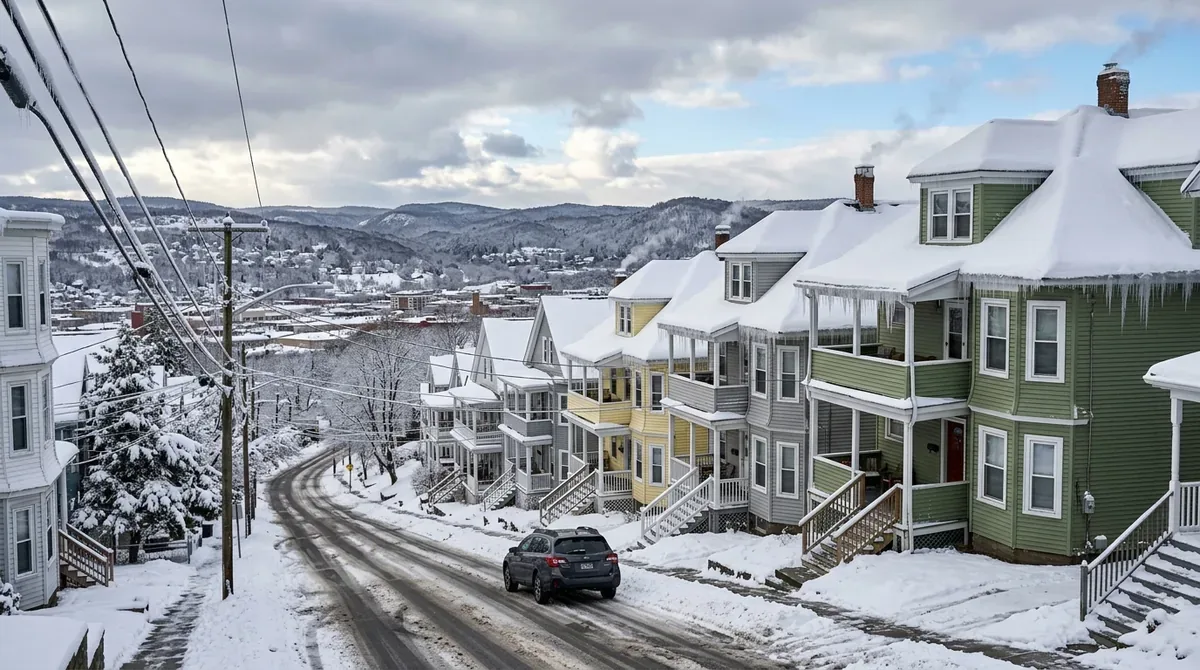
The Brass City: brass making began here in 1802, and the mills took Waterbury from about 5,000 people in 1850 to more than 100,000 by 1920, housed largely in triple-deckers and multi-family blocks. Today 29 percent of homes are in two- to four-unit buildings and 31 percent were built before 1940, on hills that climb from the Naugatuck River on both sides.
That mix decides what a roof job here looks like before any shingle is chosen. A triple-decker means three floors of staging and three households to keep dry; a Queen Anne on the Hillside means valleys by the dozen; a cape on Bunker Hill means rooms in the roof and a hard eave to detail. Each neighborhood page goes through its own.
The permit office does not change with the neighborhood – every permit in the city comes from the Department of Inspections. What changes is how much of the price is the roof and how much is getting to it.

Waterbury neighborhood by neighborhood. One city, one Department of Inspections, and housing that changes from hill to hill.
Burnt Hill, 1897-1925. Slate and clay tile survive.
Brass-family Queen Annes. Many valleys, steep lots.
Trolley-era half-acre lots. Capes with rooms upstairs.
The 1674 ridge. Farmhouses and well-kept triple-deckers.
River to ridge. Triple-deckers and six-family blocks.
Rocky hills, Washington Hill and Hopeville. Access first.
The questions that decide this job, answered before you have to ask them.
In Connecticut it is a permit line. The state's amended residential code excuses from a building permit only repairs limited to 25 percent of the roof covering within one calendar year. Under that line, on a one- or two-family house, a repair needs no permit; over it, the job is a replacement and is permitted through Waterbury's Department of Inspections. The 25 percent rule most websites describe is Florida's, which works differently. A three-family house sits outside the residential code, so check with the department before relying on the exemption there.
An asphalt roof replacement in Connecticut is estimated at $10,000 to $18,000 for most houses, with architectural shingle at about $4.50 to $8.00 per square foot installed. Slate is a different order of money, estimated at $15 to $30 or more per square foot. In Waterbury add the permit, roughly $380 on a $14,000 job, and allow for decking as a rate per sheet, because nobody knows how much is soft until the old roof is off.
For an asphalt roof on an ordinary Waterbury house, yes: it is well above the estimated $10,000 to $18,000 most houses cost, and about a tenth of the city's typical home value. It is not unreasonable for slate work, a large Queen Anne on the Hillside with many valleys, or a big multi-family building. The figure alone does not settle it; the itemized roof area, tear-off, decking rate and permit do.
Not on age alone. Twenty years is when an asphalt roof deserves an inspection, not an automatic replacement. If the shingles are holding their granules, the flashings are sound and the attic shows no water tracks, it may have several winters left. Curling, bare patches, repeated leaks at the eaves or two layers already in place are the signs that it is time, and an honest inspection says which you have.
Waterbury charges $50 for the first $1,000 of estimated cost and $25 for each additional $1,000, plus a state fee of $0.26 per $1,000. On a $14,000 roof that is about $380; on a $20,000 roof about $530. Permits come from the Department of Inspections at 185 South Main Street, and the contractor normally pulls the permit as part of the job.
Free inspection, a written quote, and a plain answer on which side of the 25 percent line the job falls.